Experts see rise in women wanting to correct botched surgery

Mr Ross has noticed a surge in patients seeking to correct botched surgery

According to Mr Ross, more women than ever are seeking to correct botched surgery after undergoing botched procedures like boob jobs.

Mr Ross says he’s seen a rise in the number of women asking for corrective treatments and surgery after undergoing unsatisfactory treatment elsewhere.

With skin rejuvenation deals on voucher sites such as Groupon, and cheaper surgical options abroad being packaged as holidays by unscrupulous doctors, he says he’s disappointed by this new trend which sees women left out of pocket and unhappy with their looks.

The leading cosmetic surgeon says a combination of unrealistic expectations and cut price surgery – both here and abroad – are to blame for the surge, as well as celebrities promoting treatments in the media.

Expert advice

Gary explains: “It was recently revealed that over 50% of women and 39% of men aged 18 to 34 would consider a cosmetic procedure, which can easily be attributed to the obsession with celebrity culture and social media apps.

“With so many celebrities endorsing products and treatments (often in return for cash) it sends younger patients flocking to cosmetic clinics looking to replicate their idols.

“Unfortunately there are many unscrupulous doctors and surgeons out there providing substandard or unnecessary treatments and procedures. They take advantage of people, and it’s causing complaints of botched results on a level we’ve not seen before.

“Groupon style voucher deals and cosmetic surgery tourism are also to blame for the rise in botched results and patients therefore seeking treatment to fix them.

“Another issue is selfies and how they have changed the way patients perceive their appearance. It was recently proven that selfies distort the proportions on the face; the most notable difference came to noses, which in some cases appeared up to 30 per cent larger than in reality.

“This is an alarming piece of research which not only details that the selfie obsession is booming, but that it’s genuinely affecting the way patients view their appearance. Unnecessary surgery often leads to unsatisfactory results.”

So how do you pick a reputable medical professional?

“Undergoing cosmetic surgery or aesthetic treatments aren’t something that should be undertaken lightly. It can be a daunting experience, and many considerations need to be made beforehand. The most important decision you will make is your plastic surgeon.
“Choosing the surgeon who will perform your surgery, as well as accompany you on your journey post operatively, cannot be rushed or underestimated.
“As well as be a highly skilled expert, a good plastic surgeon should listen to your concerns, offer constructive advice, act profession at all times, and manage expectations. It’s important when choosing surgeon that you do your research.
“Find out what their background is, what they specialise in, and how often they perform your chosen procedure. This is all helpful in allowing you to make an informed decision. Do your research and don’t be led by celebrities or cheap deals,” he concludes.

Book a consultation

For more advice on how best to correct botched surgery safely please book a consultation.
Choosing autologous fat transfer surgery

Undergoing autologous fat transfer surgery to improve the signs of ageing

For patients seeking procedures in Manchester that offer natural looking results, autologous fat transfer surgery could be the answer. Unlike other invasive procedures to tackle facial ageing such as facelift surgery, this is a more holistic cosmetic procedure.

This type of anti ageing surgery has multiple benefits and can be undertaken as a solo treatment or as part of combination cosmetic approach. Mr Ross answers some of the most commonly asked questions regarding this form of facial rejuvenation procedure in this week’s blog.

What is fat transfer surgery and why is it popular?

Popular with both male and female patients, procedures transferring fat are deigned to improve common ageing concerns such as volume loss. Fat is harvested from another part of the patient’s body, often the abdomen, before being returned to a new location. It’s also a great alternative to liposuction.

Various types of autologous fat transfer are available; which is most suitable is down to the individual. It’s becoming one of the most requested anti ageing facial rejuvenation procedures because the results are natural-looking and can be an alternative for injectable treatments and, in some cases, invasive surgical procedures.

Who is fat transfer surgery suitable for?

Autologous fat transfer is usually suitable for patients of a stable body weight who would benefit from volume enhancement. Patients need to be in good overall health and must be aware of the pros and cons of undergoing this form of facial rejuvenation.

This anti ageing surgery unlikely to be suitable for patients with unrealistic expectations of what this facial rejuvenation treatment can achieve, and those with a significant medical history. Patients must also have fat available in another area of the body in order to be eligible for this type of skin rejuvenation.
Are the results of fat transfer reliable?

For many patients, fat transfer surgery can provide excellent facial rejuvenation results. It can improve facial volume and contour the face without the need for surgery. It is useful as an anti-ageing tool, and can provide excellent results for both men and women.

The results of this anti ageing surgery are generally good, although every patient and body is different, and how one patient takes to autologous fat transfer surgery may differ to another. It’s a good idea to book a consultation to discuss the reliability of this form of facial rejuvenation compared to other options available to you.

How long does the procedure take?

In most cases fat transfer surgery takes between one and two hours. It’s advised to ask someone to collect you post-treatment, and you should expect some swelling and mild discomfort for a few days.

Can I undergo this type of anti ageing surgery alongside other cosmetic procedures?

Yes, it’s often used in combination with other facial rejuvenation methods to improve facial contours and/or improve volume that may have been lost due to weight loss or the ageing process. In some cases autologous fat transfer may be used as part of wider anti ageing surgery, for example alongside a mini facelift.

What will be covered in the consultation for fat transfer?

If you’re considering fat transfer in Manchester booking a consultation is the next step. This informal meeting allows patients to find out more about the cosmetic procedure and the setting in which it will be performed. You’ll learn about the procedure in more detail, as well as the risks, pros and cons associated with it. It’s then advised you take away that information and digest it, assessing whether or not you feel it’s best suited to you, before making a decision to go forward with treatment.

For more information about fat transfer in Manchester you can visit the treatment page, or email the team to book a consultation with Mr. Gary Ross.

Gary Ross First Plastic Surgeon To Be Certified By RCS

COSMETIC specialist Gary Ross has become the first plastic surgeon to be officially certified by a prestigious new scheme designed to boost patient safety.

Mr Ross, who operates out of the BMI Alexandra Hospital in Cheadle and the Christie Clinic in Withington, has been rubber-stamped by the Royal College Of Surgeons (RCS) Professional Standards system.

Launched in April last year, it sets-out tough industry benchmarks to help provide quality assurances for any patients looking to undergo a cosmetic procedure.

And now Mr Ross, an Honorary Senior Lecturer at the University of Manchester, is urging other surgeons to become approved themselves as he looks to safeguard the vulnerable.

Mr Ross, who recently appeared on BBC series Holding Back The Years, said: “A patient needs to have the utmost trust in the medical practitioner helping them.

“In an industry becoming increasingly tarnished by the actions of those who place profit above patient wellbeing, safeguards and checks to protect the vulnerable have never been more important.

“Which is why the new certification system launched by The Royal College of Surgeons – brought in to protect the cosmetic surgery industry and to guide patients in their life-changing choices – could prove to be one of the greatest steps forward yet, for all concerned.

“For me personally, it is an honour to be the first surgeon to have certified in cosmetic surgery through the RCS process, and I see this as a significant advance in patient care that will improve the reputation of the profession for years to come.”

Approved surgeons will be listed on the RCS website and acknowledged as highly capable in their defined areas of specialism.

It’s hoped patients will then be able to browse the RCS list and choose a surgeon who’s at the cutting edge of their chosen profession.

Mr Ross, an expert in so-called ‘mum tum’ abdominoplasty procedures and innovative fat-transfer breast augmentation operations, had to prove his competence in breast surgery, surgery of the face, nose, periorbital region and ears, body contouring surgery, and body contouring following massive weight loss,.

He explained: “In order to certify through the RCS scheme, I have provided evidence of my training, experience, and outcomes.

“I’ve provided reflection on difficult cases and showed through appraisal, revalidation, and through patient and colleague feedback, that I meet the professional standards that would be expected of a cosmetic surgeon.

“Every cosmetic surgeon should certify through the RCS – and that this should become mandatory – to safeguard patients form both physical and psychological harm.”

Stephen Cannon, Vice President of the RCS and Chair of the Cosmetic Surgery Interspecialty Committee, said ‘unscrupulous’ surgeons needed to be curbed.

He commented: “Our professional standards for cosmetic surgery, coupled with the GMC’s new guidance, will raise the bar and make absolutely clear what we expect of all surgeons working in the private sector.

“We will do everything in our powers to protect patients and to stop unscrupulous individuals from practising.”

The Royal College of Surgeons isn’t the only establishment seeking industry change.

Last month the Nuffield Council on Bioethics, an independent body that examines and reports on ethical issues in biology and medicine, called for better regulation of the cosmetic industry, and also an outright ban on clinics offering ‘walk in’ procedures to young people.

Meanwhile former Health Secretary Lord Andrew Lansley, also last month successfully tabled a private members’ bill that, if passed, will enable the General Medical Council (GMC) to note on its medical register which surgeons have been awarded the RCS’ cosmetic surgery certification.

The Care Quality Commission will also take the RCS and GMC standards into account during hospital inspections and when making a judgement about the quality and safety of services being provided.

Mr Ross, aged 45, and who lives in Sale with his wife and two daughters, adds: “All of this underlines the value of the RCS certification system and I’d encourage every plastic and cosmetic surgeon to get involved in it to become regulated and certified.

“It’s what we all must strive for.”

The RCS certification for Mr Ross comes just weeks after he was awarded a Certificate of Excellence by the popular patient review website ‘I Want Great Care.’

It was a prize that acknowledged Mr Ross’s consistently high review scores throughout the year.

And Mr Ross is also the only UK plastic surgeon to be named in the Top 500 of the RealSelf patient review website for three consecutive years.

Relevant Links:

https://www.rcseng.ac.uk/news-and-events/media-centre/press-releases/manchester-surgeon-becomes-first-to-receive-royal-college-of-surgeons-cosmetic-surgery-certification/#:~:text=Gary%20Ross%2C%20a%20plastic%2C%20reconstructive%20and%20aesthetic%20surgeonat,certification%20from%20the%20Royal%20College%20of%20Surgeons%20%28RCS%29.


https://aestheticsjournal.com/news/first-surgeon-becomes-certified-by-rcs


https://huddled.co.uk/2017/07/cosmetic-specialist-gary-ross-has-become-the-first-plastic-surgeon-to-be-officially-certified-by-a-prestigious-new-scheme-designed-to-boost-patient-safety/


https://www.rcseng.ac.uk/news-and-events/media-centre/press-releases/manchester-surgeon-becomes-first-to-receive-royal-college-of-surgeons-cosmetic-surgery-certification/


https://www.imtj.com/news/rcs-cosmetic-surgery-certification/


RCS Imagery:


First cosmetic surgery certification issued by RCS

Gary Ross recently became the first in the country to be officially endorsed to perform cosmetic surgery by the Royal College of Surgeons (RCS). You can read more about this on the National Health Executive website.

The RCS has previously been vocal in its opinions on regulating cosmetic surgery, as last month it backed a Private Members’ Bill that had been tabled to look into the issue. And today, Gary Ross, a plastic, reconstructive and aesthetic surgeon at the BMI Alexandra Hospital in Cheadle, has become the first to receive the new accreditation.

Read the full article.

Mr Ross has become the first cosmetic surgeon to be certified through the Royal College of Surgeons

It is an honour to become the first cosmetic surgeon in the United Kingdom to certify in cosmetic surgery through the RCS. The certification process aims to provide a quality assurance for patients looking to undergo a cosmetic procedure. All surgeons should be encouraged to certify through the RCS and help to raise the professional standards.

What are the new Royal College of Surgeons Professional standards?

The Royal College of Surgeons (RCS) has also published its own set of professional standards, specifically for cosmetic surgery and has launched the new certification for cosmetic surgeons.

The key points of this guidance are:-

Surgeons performing cosmetic surgery should be certified in the area in which they practise.

The operating surgeon should lead the consultation with the patient to outline the risks of the procedure, likely outcome and to provide the information that will help them decide whether or not to undergo surgery. The operating surgeon must also obtain written consent from a patient themselves – and not delegate it to a colleague.

Patients should be offered a cooling off period of at least two weeks before they consent to an operation to give them time to reflect on a decision.

Surgeons must make sure they have appropriate indemnity insurance to cover the procedures they are undertaking.

Surgeons should refrain from using financial inducements such as time-limited offers and discounts.

Stephen Cannon, Vice President of the RCS and Chair of the Cosmetic Surgery Interspecialty Committee, said:

‘Our professional standards for cosmetic surgery, coupled with the GMC’s new guidance, will raise the bar and make absolutely clear what we expect of all surgeons working in the private sector.

‘The message to surgeons and doctors working in the cosmetic surgery industry is simple: if you are not working to the surgical standards we have set out today, you should not be treating patients at all. We will do everything in our powers to protect patients and to stop unscrupulous individuals from practising.

As part of the new certification scheme the RCS will enable patients to more easily search for a surgeon who has the necessary skills and experience to perform the procedure they are considering.

Cosmetic surgeons will certify in areas of specialism that are within their scope of practice.

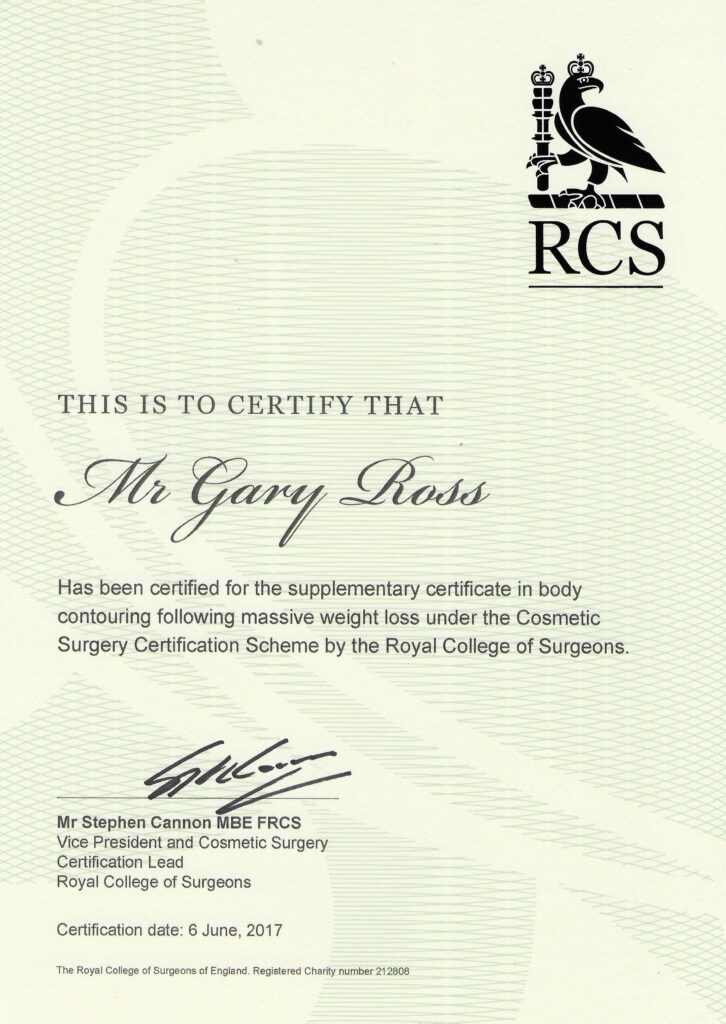
Mr Ross has certified in the following areas:-

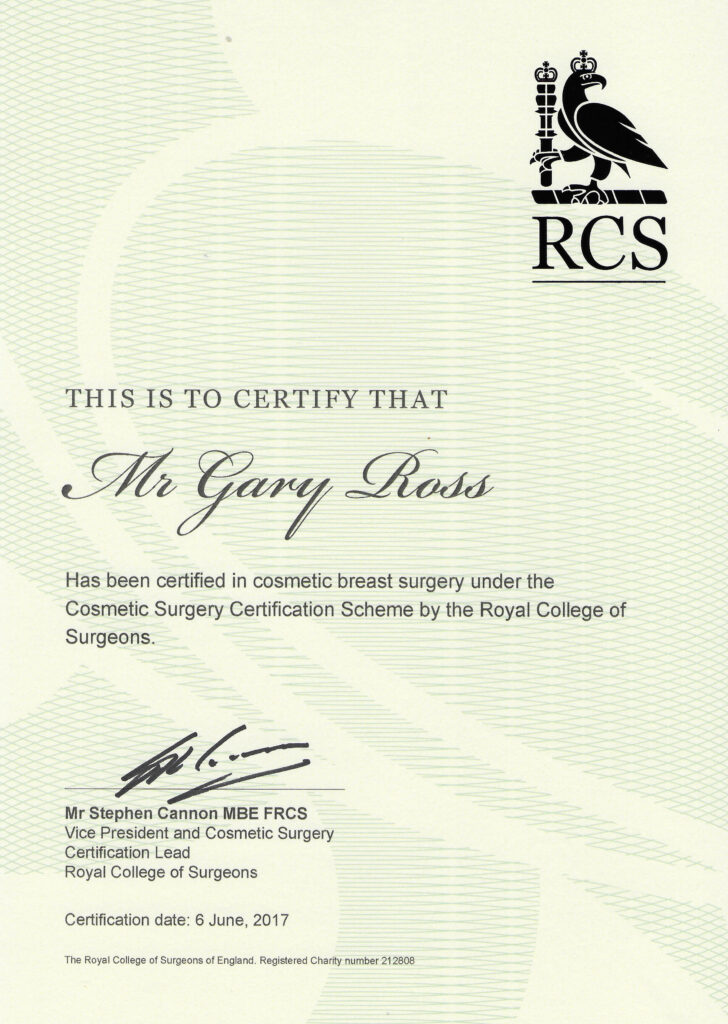
  1. Cosmetic breast surgery
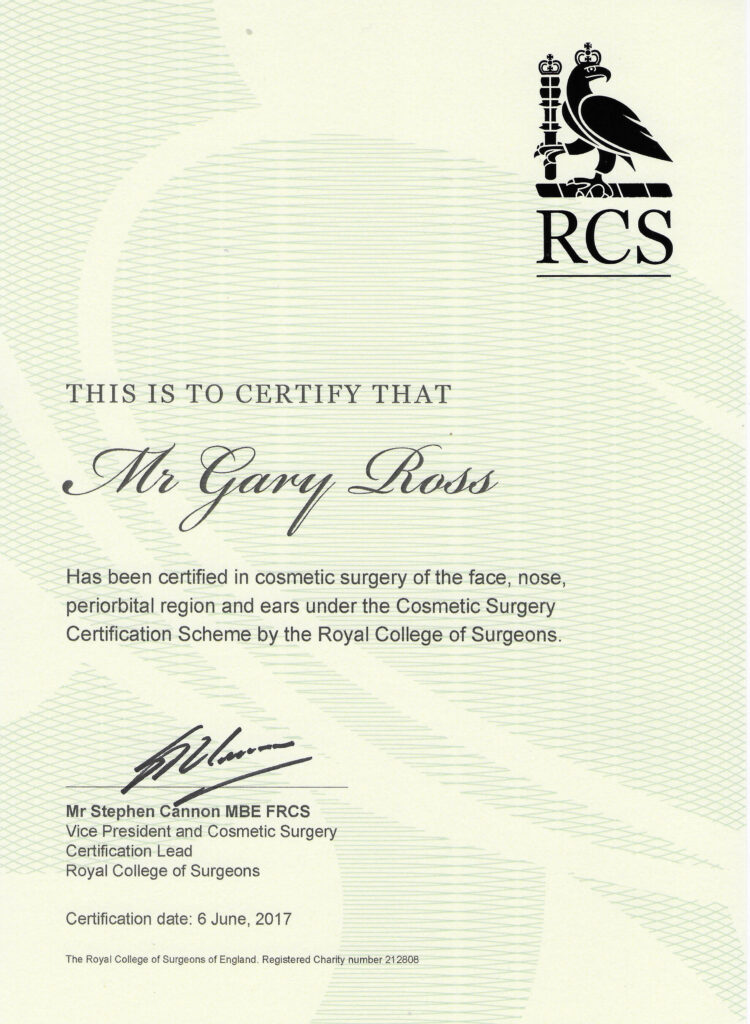
  2. Cosmetic surgery of the face, nose, periorbital region & ears
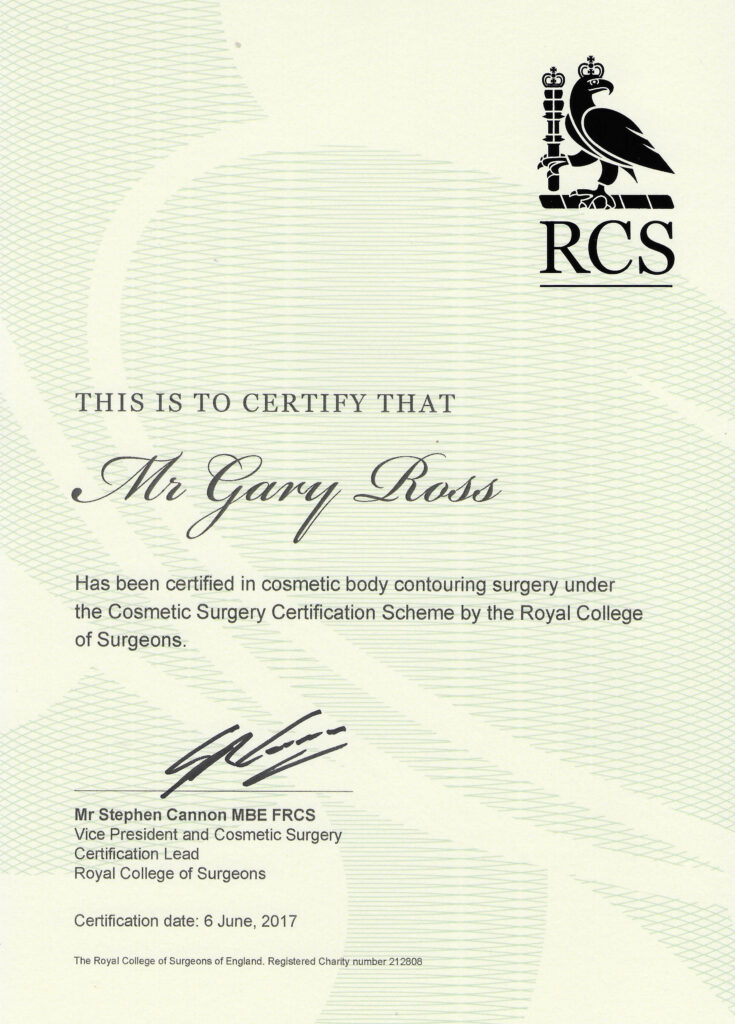
  3. Cosmetic body contouring surgery
  4. Body contouring following massive weight loss

In certifying in these areas Mr Ross has demonstrated to the RCS his training, clinical / professional skills and experience meet the professional standards set by the RCS for a surgeon that performs cosmetic surgery.

See Mr Ross talking about the new RCS Professional standards

Clicking on the links will open the videos in a new window.

What is the new RCS certification scheme?

How will surgeons outcomes be regulated?

What did I need to do to certify at the RCS?

What questions would I recommend patients to ask their surgeon preoperatively?

What are the new Royal College of Surgeons Professional Standards?

B Lite implants breast augmentation in Manchester

Mr Ross is continually developing and introducing up to date technologies and is pleased to introduce lightweight B-Lite implants into his practice.


What is a lightweight B-Lite breast implant?

Like the majority of silicone implants the implant shell is comprised of silicone and the shell can be either smooth or textured. However it is the inside of the implant where the new technology exists. Microsphere enhanced silicone gel replace the traditional silicone gel / saline. These borosilicate microspheres exhibit superior biological, mechanical, and chemical properties, such as

crush resistance, biocompatibility, inertness, and chemical resistance, making them a preferred biomaterial for demanding medical applications. Utilizing microspheres enables a substantial reduction of the implant’s weight, up to 30%, when compared with conventional silicone-filled implants of equal size. Simultaneously, their presence reduces the volume of gel required to fill the implant, further lowering its silicone content.

What are the advantages to the patient?

B Lite implants are 30% lighter to traditional breast implants and as such patients will not only weigh less for the same breast size but will have breast implants that are less likely to alter the breast and chest wall.

Gravitational weight can cause implants to bottom out and to drop down the chest wall and having a lighter implant may decrease this problem. This is an important consideration not only in breast augmentation but also in breast augmentation performed at the same time as a breast lift or mastopexy. Heavier implants have been linked to breast droop / ptosis and thinning of the breast skin / envelope with increased risk of breast atrophy and compromising tissue vascularity. Heavier implants are also thought to induce chest wall deformities due to the pressure effect on the chest wall directly and lighter implants are perceived to be less likely to cause this unfortunate complication. A lighter implant is a technological advancement.

As there is less silicone in the lightweight implants there is less chance of gel bleed over the life of the implant. Due to the patented microsphere-gel adhesion no separation and leakage is believed to occur in case of implant rupture. This is a major technological advancement.

It is believed that B-Lite gel is more transparent under mammography than normal silicone allowing more of the breast to be viewed – which will be of benefit to women especially those undergoing breast screening.

Finally it is perceived that a lot of postop pain and recovery is down to the pressure effect of the implants in the immediate postop phase. As the implants are 30% lighter this may also lead to a similar decrease in the amount of pain postoperatively. A reduction in pain postop can lead to earlier mobilisation and less down time from the procedure.

Please click here to read a peer reviewed article on B Lite implants and click here to view the B Lite breast implant catalogue.

To make a consultation with Mr Ross regarding B Lite implants please call 0161 401 4064.

iWantGreatCare announce the recipients of the iWGC Certificate of Excellence 2017

This week iWantGreatCare announced the recipients of the iWGC Certificate of Excellence 2017. This award recognises excellence by those individuals and surgeries who have put patient experience at the centre of their care. By receiving regular reviews throughout the year and maintaining a high average score, they truly deserve to be acknowledged for this fantastic achievement.

The healthcare industry both in the UK and worldwide is changing and is embracing the role that patient feedback has to play in improving services for all. iWGC wants to enable all those who work in healthcare to easily collect real-time, continuous feedback. The Certificates of Excellence acknowledges those who are leading the way in patient care and experience and the publicly available reviews will allow others to see what 5 star care is.

By gathering patient feedback to improve their services, they not only receive constructive suggestions for improvement but also heart-warming comments, written by patients who took time out of their day to say thank you.

Patient reviews are a particularly good resource for patients wishing to undergo plastic surgery procedures, for those researching treatments and surgeons. Mr Ross is not only the most highly rated plastic surgeon in the UK but also the highest rated surgeon of any discipline in the UK.


Gary Ross Ranked one of the Top 500 Plastic Surgeons in the World

It is a great honor that Mr. Gary Ross has been listed as one of only 500 doctors from around the world who has been awarded the prestigious Real Self 500 Award 2016!

Mr. Ross has been named in the real self top 500 for the last 3 years and is the only plastic surgeon in the UK to have achieved this accolade.

The Real Self 500 award is based on three criteria: the quantity and quality of patient reviews, engagement with the Real Self community via questions and answers, and the sharing of before and after treatment photos.

The full list of awarded doctors is available at https://www.realself.com/RS500

The Real Self 500 Award honors the top rated and most engaged board-certified aesthetic doctors who consistently demonstrated a commitment to patient education and positive patient outcomes throughout 2016. This elite group of doctors has excelled at sharing their expertise, free of charge, with tens of millions of Real Self community members actively searching for information and the right provider.

What is Real Self? It is the largest online destination to get informed about elective cosmetic procedures and to find the right doctor or clinic. More than 9 million people visit Real Self each month to find out which treatments and providers live up to their promise of being “Worth It.” Real Self is powered by unbiased experiences shared by consumers for hundreds of treatments, ranging from simple skincare to highly considered cosmetic surgery. Offering millions of photos and medical expert answers, Real Self has become the essential resource and service for those seeking to find the right doctor or clinic.

Tom Seery, Founder and CEO of RealSelf. “Our research shows that more than 95 percent of patients expect a practice to engage with them online. These doctors are leading the way in terms of their online engagement and focus on empowering patients with good information.”

Mr. Ross aim as a plastic surgeon is help patients to be empowered to make their own decision of whether plastic surgery is right for them. He always encourages those considering any treatment to invest a lot of time in research. This includes researching a range of surgeons and their professional background as well as the benefits and potential risks. By completing in depth research on a procedure and fully understanding aspects such as the recovery period, patients can make an informed decision. Real self is a valuable online resource for patients.

MSc in Skin Ageing and Aesthetic Medicine. Improving quality of practice and making things better.

By Ben Chun Man Lee, Arshid Hussein Nabila Muzaffar Rajani Nalluri Gillian Yates

Has your cosmetic provider got a university degree or done a one day course?

The MSc in Skin Ageing and Aesthetic Medicine at the University of Manchester is an intensive course that looks at all aspects of skin science and skin aging. Selection is competitive and the aim is to train future leaders in aesthetic practice by offering a high quality programme at an internationally recognized institution. A basic requirement is a medical or dental degree. Over three years only the best will succeed and will be able to apply these enhanced knowledge and skills in helping to empower patients.

MSc in Skin Ageing and Aesthetic Medicine is a patient focused course and you obtain a perspective in the whole field of aesthetics enabling you to deliver an unbiased overview and deliver evidence based care. So what that means for you as a patient by choosing a practitioner with an MSc in skin aging – you will be given the most appropriate treatment options for your aesthetic and cosmetic concerns.

MSc in Skin Ageing and Aesthetic Medicine is a programme taught by experts across all fields including dermatologists, plastic surgeons, oculoplastic surgeons, maxillo-facial surgeons, dentists and psychologists in addition to skin ageing and wound research basic scientists.

MSc in Skin Ageing and Aesthetic Medicine offers a unique perspective and allows you to be able to discuss the pros and cons of the various treatment options.

Looking youthful is a social requirement and is in increasing demand. Avoiding the pitfalls is essential. If you want the best quality look for a dedicated professional. When it comes to your face quality should be your priority.

Further details regarding the MSc in Skin Aging at the University of Manchester are available at:-
https://www.manchester.ac.uk/study/masters/courses/list/09805/msc-skin-ageing-and-aesthetic-medicine/course-details/

Five good reasons to demand your clinician should have an MSc in Skin Ageing and Aesthetic Medicine

By Deirdre Jones, Clare Kiely Tristan Mehta, Richard Morgan, Pavan Sambi, Jinah Yoo

Did you know that fillers can cause blindness?

Has your cosmetic practitioner every heard of central retinal artery?

Have you heard of the use of hyalase in cosmetic medicine?

Do you know what a granulomatous reaction is?

Is your practitioner insured?

The answer to these questions is likely to be no.

  1. More and more people are looking to enhance their cosmetic appearance but what do they know about the skills and training of the practitioner. Do you know of the life changing possibilities of the treatments that you are receiving? Are you able to differentiate between practitioners?
  1. The MSc in Skin Ageing and Aesthetic Medicine at the University of Manchester is a unique industry-leading course, which develops advanced skills and knowledge required to deliver clinical excellence and improve patient safety.
  1. The MSc in Skin Ageing and Aesthetic Medicine led by an international faculty of dermatologists, plastic surgeons, oculoplastic surgeons, maxillo-facial surgeons, dentists and psychologists in addition to skin ageing and wound research basic scientists. It aims to deliver evidence based care in cosmetic practice.
  1. Participants in the MSc in Skin Ageing and Aesthetic Medicine are trained in how to provide optimal outcomes for patients, understanding how to manage patient expectations and to provide a holistic approach to individualised care.
  1. The MSc in Skin Ageing and Aesthetic Medicine may perform the basis of Mandatory regulation, raising standards within Health Education England. This may lead to a public register of qualified practitioners to acknowledge all practitioners who have a postgraduate qualification in aesthetics.


Further details regarding the MSc in Skin Ageing and Aesthetic Medicine at the University of Manchester are available at:- https://www.manchester.ac.uk/study/masters/courses/list/09805/msc-skin-ageing-and-aesthetic-medicine/course-details/